
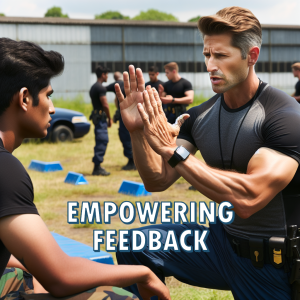
Empowering Feedback
Effective feedback plays a crucial role in learning and skill development while improper feedback methods can impair learning. Unfortunately, however, research has shown that the majority of coach or trainer feedback used in law enforcement is of the type that hinders retention and transfer of performance.
Feedback is an essential component of effective learning of both cognitive skills, motor learning and personal growth that helps individuals understand their strengths and weaknesses. When feedback is provided at the correct time, is of the correct type and delivered in a clear, constructive manner, it not only boosts learning but also enhances motivation and confidence.
Moreover, effective feedback fosters a sense of accountability for learning and problem solving and encourages self-reflection. Effective coach feedback during learning not only leads to immediate improvements but also fosters long-term personal and professional growth.
Furthermore, the role of peer feedback has gained recognition in collaborative learning environments. When students assess each other’s work, they not only reinforce their own learning but also develop critical analysis skills. This process creates a supportive learning culture where individuals feel more comfortable discussing their ideas and challenges, leading to collective skill development as well as independent and adaptable problem-solving.
By embracing the value of effective feedback methods, coaches and trainers can greatly enhance their students’ learning experiences and enable them to achieve their goals more effectively. As law enforcement training continues to evolve and reform, the need for coaches and trainers to understand the effective use of feedback will remain a cornerstone of successful learning and growth.
Coaches and Trainers attending “Empowering Feedback” course will:
- Learn the psychological / cognitive underpinnings for how language is processed.
- Understand the different types of feedback – Inherent and Augmented
- Demonstrate how to use ‘knowledge of results’ rather than ‘knowledge of performance’ feedback
- Explain the importance of student motivation and how feedback can either bolster, or impair, student motivation
- Learn the relationship between feedback types and the students focus of attention
- Understand the danger of creating students who are ‘feedback dependent’ and how to avoid this from happening
- Learn the use of video as a feedback tool
- Demonstrate the proper type and timing of feedback to optimize self-directed problem solving
- Explain and demonstrate the use of Bandwidth feedback – what it is and how to apply it to maximize feedback potential for motor learning.
This 8-hour course consists of didactic presentation, pair work, group work and practical problem-solving exercises to help the students understand and cement the concepts of using effective feedback methods.
For more information about this course or to explore hosting the “Empowering Feedback” course, contact us today at info@raptorprotection.com