
Going Non-Linear
Explain the difference between information processing theory and ecological dynamics
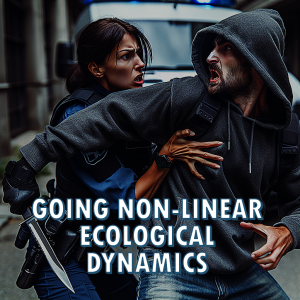
Understanding and Applying Ecological Dynamics Course Introduction
First responders are required to make high-consequence decisions in highly ambiguous and rapidly evolving environments. These types of performance domains are termed ‘non-linear’. In the Non-Linear world, first responders are required to be highly resilient and adaptable; to have exceptional awareness and attentional control and to be able to focus on what’s important now and what’s likely going to happen next.
Ironically, despite the fact that being able to perform well in these highly non-linear environments requires non-linear learning environments, the majority of law enforcement skill acquisition training neither designed or delivered in a way that lends itself to effective retention and transfer of skills.
Very recently, there is a growing number of law enforcement coaches and trainers who have been exploring a completely different methodology of skill acquisition – Ecological Dynamics. While Ecological Dynamics has been studied and used effectively in competitive sports, and even in nursing, search and rescue, and aviation, it is only now beginning to be studied and encouraged as a better way forward for law enforcement trainers.
What is Ecological Dynamics?
Ecological dynamics refers to the interaction between organisms and their environments, highlighting how these interactions influence behavior and skill acquisition. In the context of motor skill learning, especially within nonlinear environments such as outdoor sports, dynamic team games, and occupations that are faced-paced and often unpredictable, understanding ecological dynamics is crucial. This course explores the importance of these dynamics in developing motor skills and offers insights on how coaches and trainers can facilitate more effective learning experiences for their students.
One of the primary aspects of ecological dynamics is that it recognizes the role of the environment in shaping movement and behavior. In nonlinear contexts, changes in the environment—such as differing terrain, lighting conditions, injuries, or the unexpected presence of other people or threats—require first responders to adapt their attention, decisions, actions and movements accordingly This adaptability fosters not only the development of motor skills but also the ability to make quick decisions under pressure – the hallmark of exceptional first responder performance.
Furthermore, ecological dynamics emphasizes the importance of learning through exploration and experience. Traditional approaches often rely on repetitive practice in static conditions, often with minimal context, which may not effectively transfer to real-world situations. In contrast, when learners are placed in varied environments where they must actively engage with changing variables, they develop a better understanding of their capabilities and the task at hand. A recent study illustrated that officers who trained in diverse, contextual and non-linear conditions significantly improved their adaptability and problem-solving skills compared to those officers who practiced in controlled, linear and static environments.
Nonlinear environments often necessitate teamwork, where officers must continuously learn and adapt from one another. This shared learning experience is essential in building not just individual skills but also team cohesion and Ecological Dynamics has been shown to result in greatly enhanced team-based decision making.
Additionally, ecological dynamics encourages learners to understand the feedback loop between their actions and the environment. By receiving immediate spatial and contextual feedback, individuals learn to refine and adapt their skills in real-time. Of course, this desired ability leads ultimately to improved performance in the ‘real world’.
The ’Going Non -Linear’ course will help coaches and trainers learn how applying Ecological Dynamics can significantly enhance motor learning, leading to more competent and confident performers in the field.
Learning Outcomes:
Coaches and Trainers attending ‘Going Non-Linear’ Understanding and Applying Ecological Dynamics course will:
- Describe the freedom of movement problem and the ‘myth’ of the repeatable technique.
- Articulate the importance of context and variability during skill acquisition.
- Discus how an ecological dynamic approach reduces the chances for injury.
- Explain the critical relationship between the coupling of perception and action.
- Describe why ‘self organization’ during learning leads to better performance in ambiguous environments.
- Explain the ‘Constraints Model’ and demonstrate how the CLA is understood and applied in the first responder skill learning environment.
- Be able to define ‘Invariances’ in skilled movement and how coaches and trainers need to identify and apply these.
- Discuss the ‘Scaling Effect’ as it relates to the development of effective motor skill learning environments.
- Explain the role of ‘Affordances’ and how to create a learning environment where students detect and react appropriately to the appearance of affordances.
- Articulate the importance of outcome-focused movement rather than technique-focused movement and how the former creates much superior adaptability.
- Understand the role of error in motor learning and how intelligently created pressure environments will intentionally allow for error to occur for beneficial learning.
- And much more!
This 16-hour course consists of didactic presentation, pair work, group work and practical problem-solving exercises to help the students understand and cement the concepts of applying an Ecological Dynamics approach to training.
For more information about this course or to explore hosting ‘Going Non-Linear’ Understanding and Applying Ecological Dynamics, contact us today at info@raptorpublicsafety.com